
How an Idea Became a European Educational Project
– The Future of Education in the Alpine Region
– The Alpine Region as a Cultural Landscape
– The Role of an Academy in the Alpine Region
The European Alpine Academy arose from a simple question: What does the future hold for education in the Alpine region?
When it became apparent in the early 2020s that the historic boarding school at Ettal Abbey was facing profound changes, an intense discussion began within the James Loeb Society about the future of cultural and humanistic education in the Alps. Such a traditional cultural institution must not be left in the hands of stakeholders and corporations with commercial interests. Abbot Barnabas was immediately approached with the idea of founding an Alpine Academy to combine the monastery’s tradition and Europe’s intellectual heritage with the demands of the present.
It quickly became clear that the challenges extended far beyond Ettal. Digitalization, social change, and the growing alienation from nature and cultural tradition presented educational institutions throughout the Alpine region with new challenges.
The Founding of an Academy
Our proposal was very simple: For three years, we would test the viability of the concept of an Alpine Academy, and at the end of that period, we would hand over our feasibility study to the monastery. In 2022, the European Alpine Academy was officially founded in Ettal. From the very beginning, its goal was not to create yet another traditional summer school, but rather an international forum for culture, science, philosophy, and questions about the future of society.
The Academy views the great Alpine region as a cultural landscape of Europe. For centuries, the Alps have connected the North and the South, bringing together different languages, traditions, and ways of thinking. The European Alpine Academy builds on this historical role.
The Trial Phase
From 2023 to 2025, the foundations of the project were systematically developed. The first academies focused on the question of what role a modern Alpine Academy could play in the 21st century. Topics such as humanism and digitalization, cultural heritage, sustainability, regional identity, and European cooperation were discussed. At the same time, a growing network of partners and supporters from academia, culture, and civil society emerged:
Collections of Antiquities and the Glyptothek
In Munich, Dr. Florian Knauß, director of the State Collections of Antiquities and the Glyptothek, agreed to support the Alpine Academy project.
Murnau Castle Museum
Dr. Uhrig, the director of the Murnau Castle Museum, also advocated for an Alpine Academy in the Zugspitze region/Blauen Land.
Ödon-von-Horváth Society
Gabi Rudnicki and Georg Büttel, two energetic members of the Murnau Ödon von Horváth Society, were quickly on the scene.
Murnau Clubs
Clubs in Murnau, such as the Uffing Shooting Club, welcomed the Alpine Academy with open arms.
Maker Lab
Jessica Kampmann-Albrecht and Maximilian Benn from the Maker Lab at the James-Loeb-Haus in Murnau supported the participants throughout all the creative processes.
Early Supporters
Early supporters included, among others, Dr. Florian Knauß, director of the State Collections of Antiquities and the Glyptothek in Munich; Dr. Sandra Uhrig of the Murnau Castle Museum; representatives of the Ödön von Horváth Society; numerous local organizations; as well as the Maker Lab at the James Loeb House in Murnau and the advertising and communications agency Seitwerk in Uffing.
Artists and cultural professionals
Even artists and cultural figures from the Blauen Land region played a part in the academy’s development.
Villa Riedwies
Artist Stefanie Speermann has transformed Villa Riedwies in Murnau into an important venue for creative encounters and interdisciplinary collaboration.
Alumni of Ettal Gymnasium
Brought together by Roland Jurgeleit, a former teacher of Ancient Greek at Ettal, through the Timaios Society (www.timaios-gesellschaft.de). We have been collaborating for years with participants of the Alpenakademie on future-oriented projects focused on the “modern reappraisal of (ancient) philosophy and culture.”
Ugo Dossi
The internationally renowned artist from Murnau, ultimately played a decisive role in helping the Alpenakademie secure startup funding from a U.S. foundation in 2024.
Patron from Murnau
As recently as 2024, a patron from Murnau provided substantial funding for a center for religion and philosophy at the University of Munich.
A partnership with this center alone could serve as another major pillar of support for an Ettal Alpine Academy.
Relationships with Universities
Innsbruck, Bolzano, Thessaloniki, Gothenburg, Aarhus, and Harvard.
From a Regional Idea to a European Network
Over the years, it has become increasingly clear that an Alpine Academy can only be successful in the long term if it is conceived within a European framework. For this reason, contacts have been established with universities and research institutions in several countries. Today, the network includes partners in Germany, Austria, Italy, Greece, Sweden, Denmark, and the United States.
Relationships with universities in Innsbruck, Bolzano, Thessaloniki, Gothenburg, and Aarhus are of particular importance. In addition, there are connections to international partners in the U.S., including contacts within the Harvard University community.
The Blue Land as a Laboratory for the Future
From the very beginning, the Academy has been closely linked to the Blue Land. The region surrounding Murnau, Staffelsee, and the Ammergau Alps uniquely combines cultural heritage, scenic beauty, artistic tradition, and social innovation. Here, the conditions are ideal for reexamining the relationship between people, nature, technology, and culture. The Academy therefore views the Blue Land as a European laboratory of the future, where new forms of humanistic education can be tested.
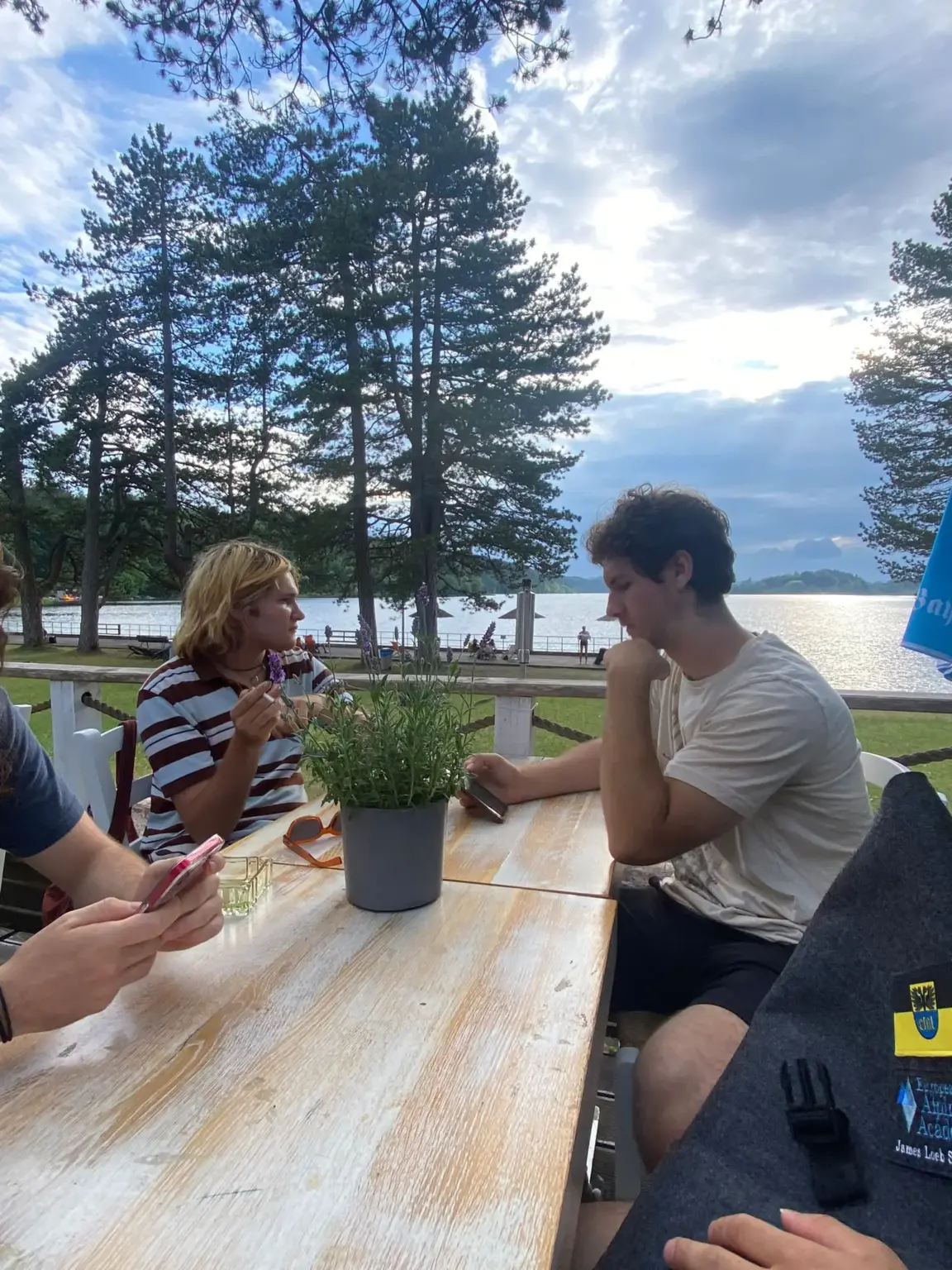
Unfortunately, in 2025, just a few days before the Academy participants were due to arrive, Ettal abruptly terminated its collaboration with the James Loeb Society. Had it not been for the swift, unbureaucratic assistance of Murnau’s mayor, Rolf Beuting (who organized accommodations for the Academy participants in Murnau virtually overnight) the project for an Alpine Academy in the district of Garmisch-Partenkirchen would have suffered significant damage. Michaela Urban and Heinz Reil from the Murnau Nature Friends Association ultimately offered the Alpine Academy the “Georg-Rauch-Haus” on Staffelsee as a place to stay, without any red tape.
Outlook
Today, the European Alpine Academy’s goal is to further expand its international network and to develop European educational and cultural projects in collaboration with its partners.
At the heart of this effort is the conviction that the major challenges of our time cannot be solved by technical or political means alone. What is needed is education, cultural understanding, international cooperation, and a new way of thinking about the role of humanity in nature and society.
The European Alpine Academy sees itself as a contributor to this dialogue. It builds on the humanistic tradition of James Loeb and combines it with a European perspective for the future.