
James Loeb and Music
– Antiquity & Humanism
– Education & Culture
– Democracy & Ethics
In addition to archaeology, ancient art, and classical philology, music was another of James Loeb’s great passions. His mother, Betty Loeb (née Gallenberg), came from a family of musicians in Mannheim (her father was the first violinist in the Grand Ducal Orchestra in Mannheim). She was a pianist and violinist who had trained at the Paris Conservatoire to concert level. At the Loeb home in Cincinnati and later in New York, she fostered a rich and high-quality musical life through regular chamber music matinees featuring family members (excluding the father) and guests.
James Loeb received early instruction in cello (as his primary instrument), piano, and organ. According to his nephew James Paul Warburg, he was the only one among his siblings with true musical talent. An excellent cellist throughout his life and a pianist of nearly equal skill, he was involved in the public musical life of his American homeland from an early age and long after his move to Germany. He is known for his contributions to the founding of the Institute of Musical Art (together with Frank Damrosch) and for preserving its successor institution, the later world-famous Juilliard School of Music.
An excellent musician
In Munich, Loeb hosted a sophisticated musical salon. At regular chamber music matinees, he played the cello part in string quartets by Haydn, Mozart, Beethoven, and Schubert, whom he particularly loved. But he was also familiar with the contemporary music scene of the time. The composers Max Reger, Hans Pfitzner, Richard Strauss, and even Gustav Mahler—whose symphonies he had heard and admired—are said to have been guests at his Munich townhouse. Later, in Murnau, playing music regularly in an ensemble or (alone) at the piano was time and again a source of emotional renewal for him after periods of depressive inactivity that often lasted for years.
James Loeb was an excellent musician throughout his life, both as a pianist and a cellist. For 50 years, his music collection was considered lost after his library in Murnau was dismantled. A significant portion of it was rediscovered in the music department of the Augsburg City Library.
Augsburg Public Library
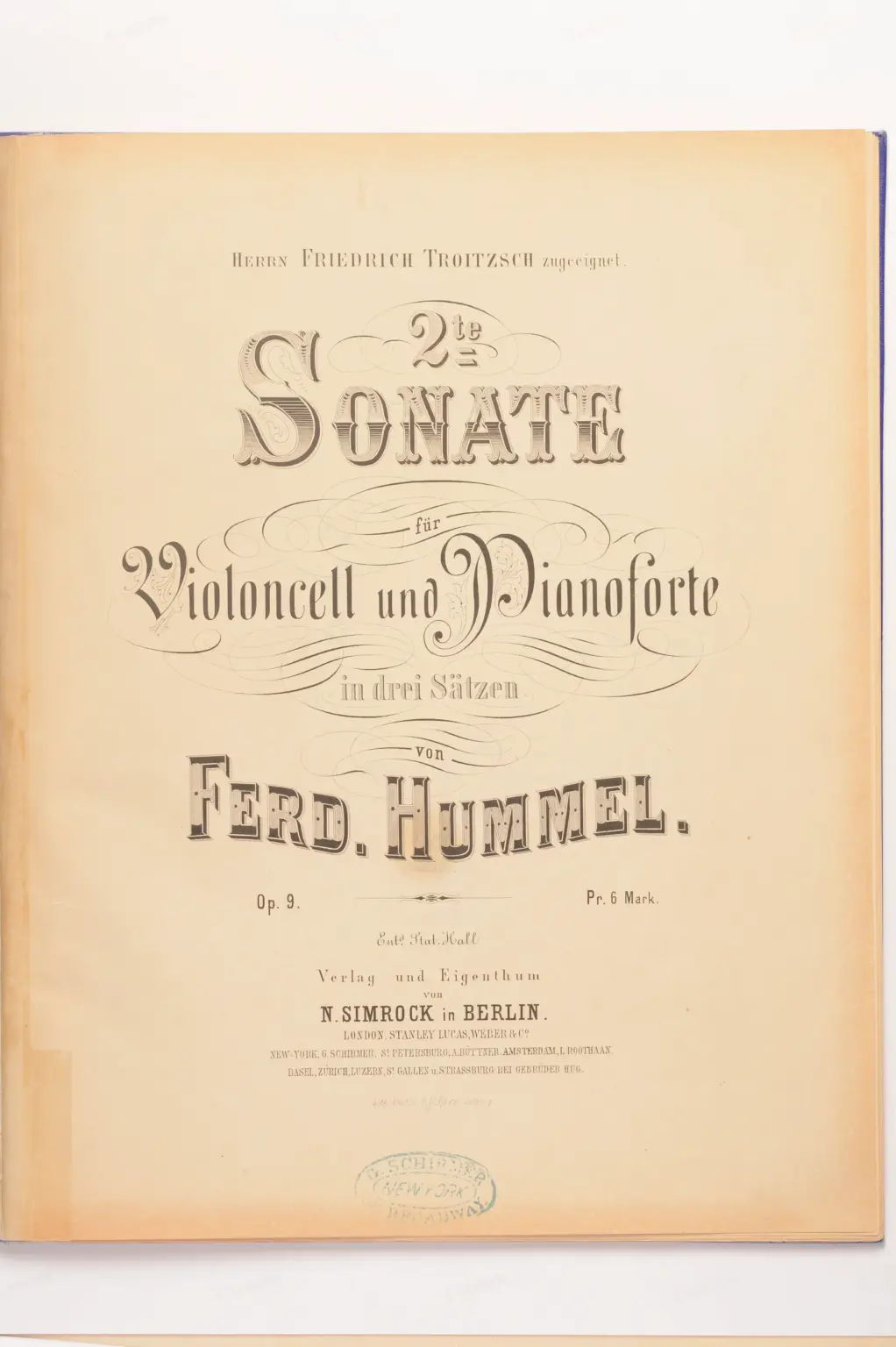
In 2012–2013, the Augsburg City Library and the James Loeb Society e.V. exhibited for the first time a selection from James Loeb’s once-extensive sheet music collection. Rare late-Romantic music prints offer a glimpse into one of the glamorous upper-class music salons of the United States around 1900.
Entire library dissolved
After James Loeb’s death, his extensive library largely survived in the Murnau villa through World War II and into the 1950s. A catalog compiled in 1946 under the supervision of the American occupation forces lists, among the approximately 10,000 volumes of archaeological, art-historical, philological, philosophical, agricultural, and literary works, 213 volumes of sheet music as well as 163 volumes of musicological literature. The entire library was dismantled in 1960 to make way for the conversion of the library hall into a chapel for the convalescent home and was largely sold through a Bonn-based antiquarian bookstore, thus “scattered to the four winds.” The music materials, too, have been considered lost ever since.
A Significant Part Rediscovered
A significant portion of this collection has been rediscovered in Augsburg. Ninety-five music volumes—nearly half of the former Loeb music collection—have been in the possession of the Music Library at the Augsburg Public Library for decades.
- 18 of these volumes bear James Loeb’s handwritten signature on the title page (see Example 1), while another 26 volumes bear the owner’s stamp “James Loeb.”
- With the exception of a few cases of doubt, 51 additional volumes were identified as originating from the Loeb Music Collection based on the inventory list and the similarity of their bindings.
- 10 of the volumes identified by name—and in some cases by signature—do not appear on the 1946 inventory list, the only known catalog of the Loeb Library to date; they may therefore be considered previously unknown finds.
Unrecognized for decades
In the spring of 1961 (shortly after the dissolution of the Loeb Library), the then-Augsburg Municipal Public Library acquired the sheet music collection from the Augsburg music store Anton Boehm & Sohn, which also operates a Catholic church music publishing house. The sheet music volumes had apparently found their way there via the Diocese of Augsburg, and evidently without the crucial background information regarding the collection’s origin. As a result, the volumes were initially integrated “incognito” into the regular, lendable sheet music collection of the municipal music library for decades.
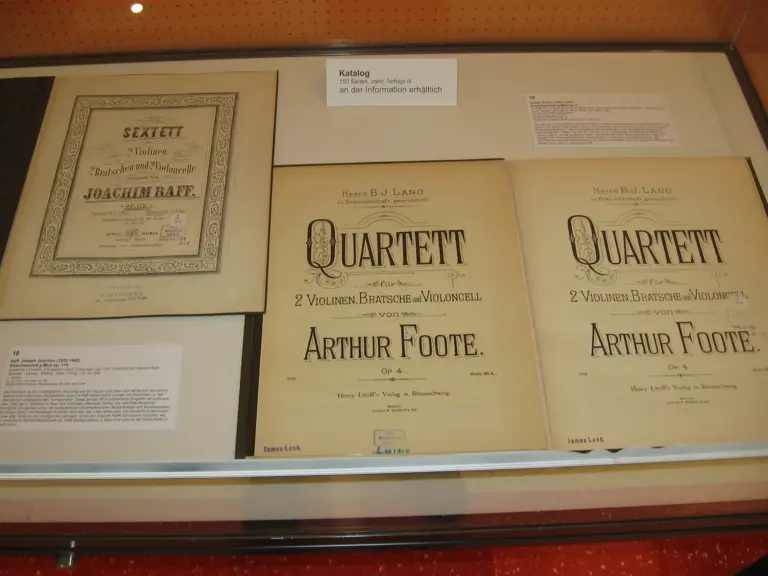
The large-format volumes and slipcases, bound in black with gold embossing, contain primarily sheet music from the late 19th and early 20th centuries. Among them are several valuable first editions of chamber music works by composers such as Brahms, Dvořák, Tchaikovsky, Rimsky-Korsakov, Richard Strauss, and others, as well as many other chamber music rarities in rare early editions.
However, Loeb clearly did not act as a bibliophile collector in this field (sheet music), but rather—despite his keen sense of quality and historical value—approached the acquisition and care of his music collection from a practical, performance-oriented perspective: works for the same instrumentation are bound together into complete sets. Prints that have become valuable over time can be found there alongside plain, run-of-the-mill editions (some of which are still sold today).
The music collection clearly did not form part of his official scholarly library. Rather, given its origin and intended purpose, it was of a purely private nature. Not a single music volume bears his bookplate with the well-known motto “Opes adipiscendae ut dignis largiamur” (Acquire wealth so that we may give to those who are worthy). Many, however, bear his personal signature. Some volumes, if not the majority of the collection, may have come from his mother’s music collection in the Loeb family home. This is suggested by bindings elegantly ornamented in the style of the late 19th century (Example 2) as well as license stamps from American representatives of German music publishers (e.g., Schirmer, Example 3) found in some old editions.
Notwithstanding Loeb’s preference for the string quartets of the Viennese Classics (see above), the focus of the Augsburg collection—as well as of Loeb’s chamber music collection as a whole—is clearly on chamber music for strings with piano. On the one hand, the focus was on composers of the generation around 1830–1840 (Brahms, Dvořák, Tchaikovsky, etc.), who, during Loeb’s youth, were among the established and leading figures in the American music scene (thanks, in part, to the transatlantic presence of their European publishers). On the other hand, there was also a specifically German repertoire, cultivated in the bourgeois salons of the late 19th century and largely unfamiliar today. The collection was thus clearly shaped by the musical tastes of his mother’s family tradition.
Make it available to the public
The music collection of the Loeb Library at the Augsburg Public Library, a treasure of the highest order in the history of music and culture, is currently unavailable for regular borrowing. However, they are intended to be made accessible to the public again in the future—through exhibitions and concerts, among other initiatives, in collaboration with the James Loeb Society e. V.—thus fulfilling the spirit of James Loeb, who always found comfort and solace from his suffering in music, for a charitable cause.
- Example 1:
A. Dvořák, Piano Quintet, Op. 81, Berlin: Simrock 1888
[First edition, signed by James Loeb on the title page] - Example 2:
P.I. Tchaikovsky, String Sextet “Souvenir de Florence,” Op. 70
[Cover of the first violin part] - Example 3:
N. Rimsky-Korsakov / A. Lyadov / A. Borodin / A. Glazunov, String Quartet “B-la-f,” Leipzig/Moscow: Belaieff 1887
[First edition, G. Schirmer, New York license stamp on title page]
Dr. Robert Forster
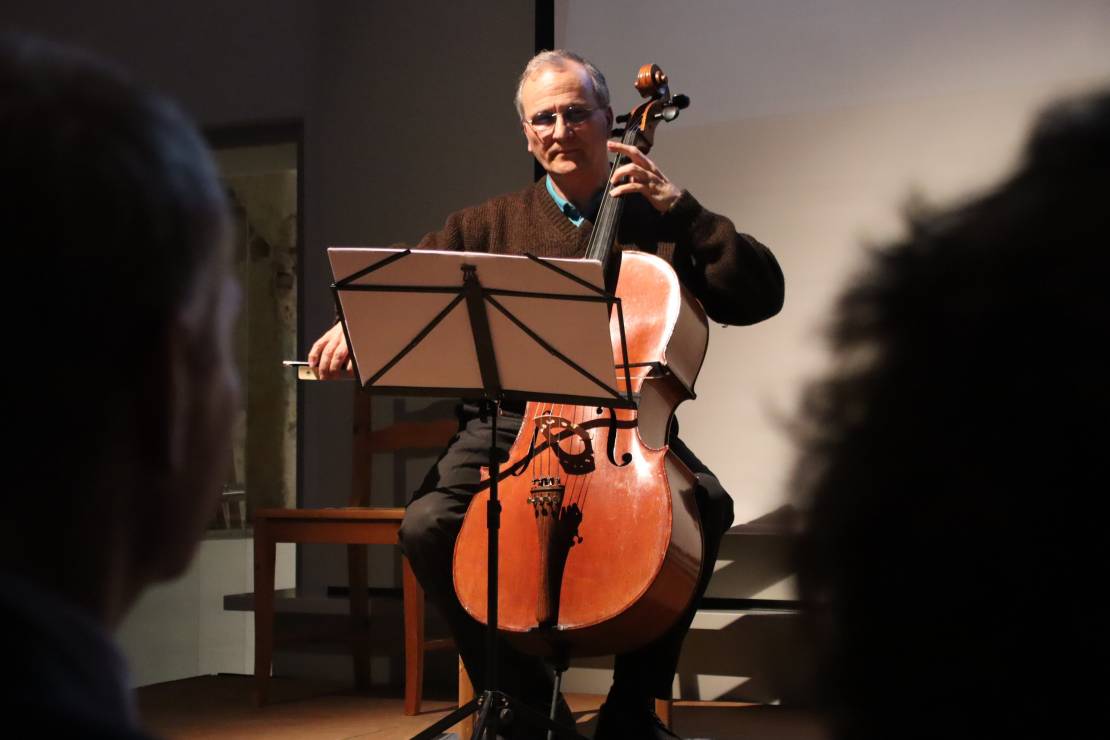
Concerts are still held based on James Loeb’s collection of sheet music. In recent years, there have been regular concerts at Murnau Castle or at the James Loeb Villa at the Hochried Clinic.