
The Gravesite of James and Marie Antonie Loeb
A place of remembrance that continues to tell stories to this day
A place of remembrance, full of mysteries
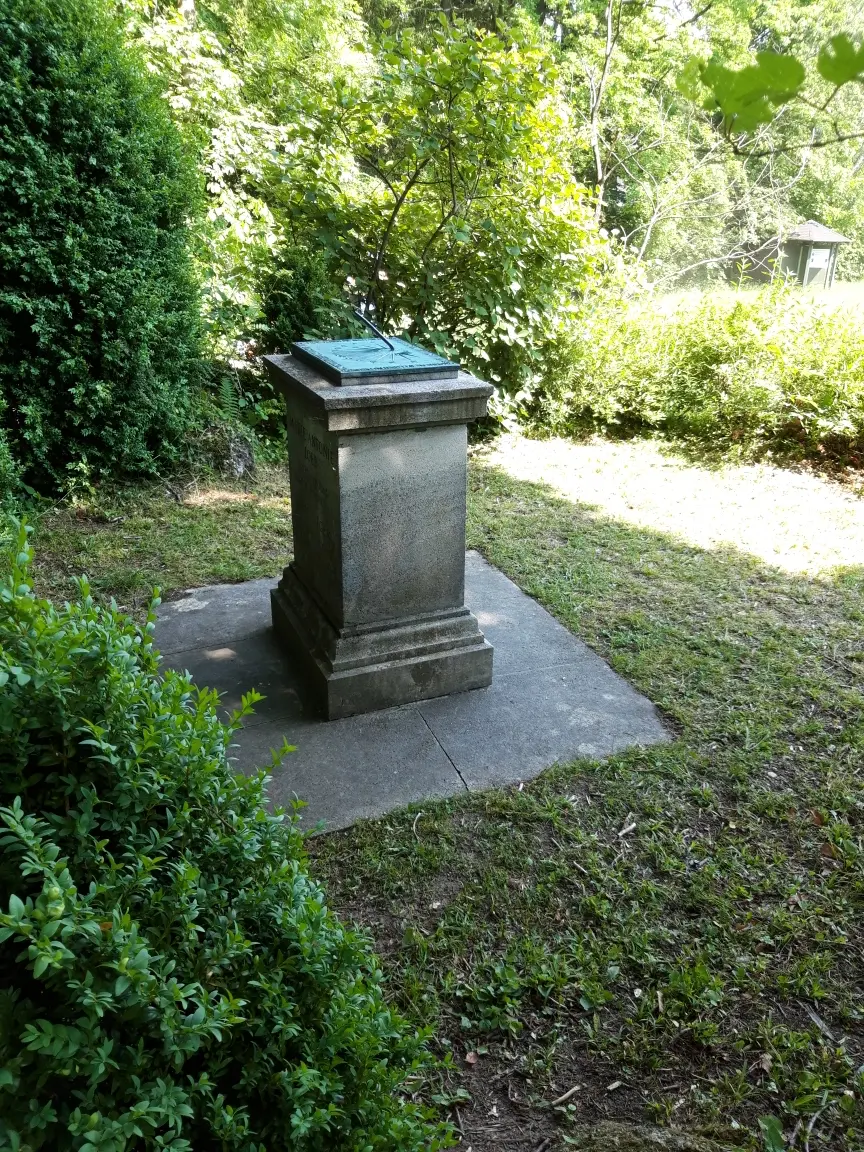
The gravesite of James Loeb (1867–1933) and his wife Marie Antonie Loeb (1864–1933) is one of Murnau’s quiet places of remembrance. It is located west of Hochried on Marie-Antonien-Weg, on a hill offering a sweeping view of the Ester Mountains. Here, an extraordinary memorial stone featuring an artistically designed sundial commemorates the pair.
This place holds special significance for the James Loeb Society. The international Loeb conferences held to support the Loeb Classical Library Foundation at Harvard University traditionally begin with a visit to James Loeb’s former country home in Hochried and then proceed to his gravesite.
Their grave raises several questions that have not yet been conclusively answered.
- Why were James and Marie Antonie Loeb buried outside their estate?
- Who designed the memorial stone with the sundial?
- Who wrote the poetic inscription?
The Memorial Stone
The memorial stone, made of tuff, bears the couple’s dates of birth and death.
Marie Antonie Loeb
July 13, 1864 – January 28, 1933
James Loeb
August 6, 1867 – May 27, 1933
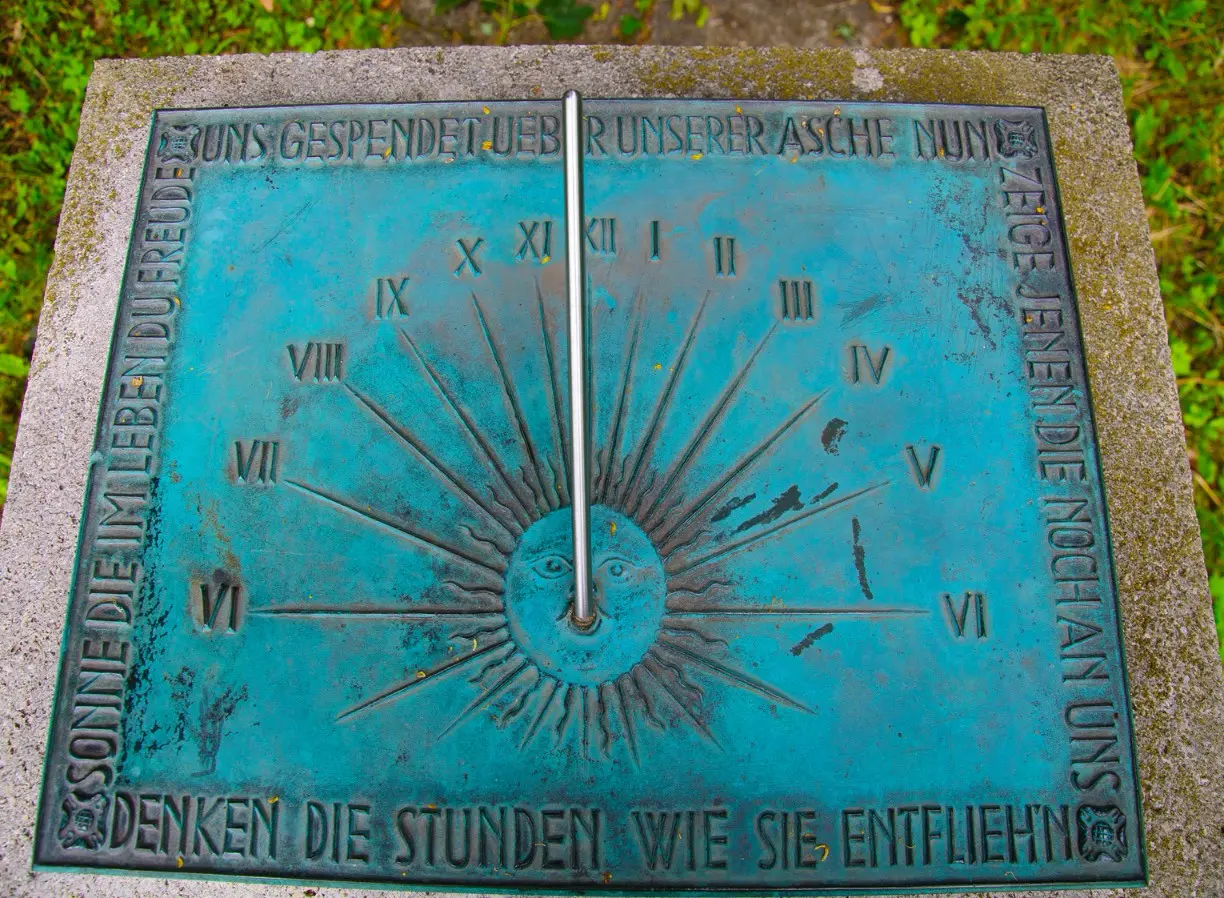
The top of the monument features a square metal plate in the shape of a sundial, whose gnomon marks the sun’s path.
The Sundial
The sundial bears a circumferential inscription that conveys the character of this memorial site in a particularly striking way: “Sun, you who brought us joy in life, now, over our ashes, show those who still think of us the hours as they slip away.” The connection between time, transience, and memory makes the sundial an extraordinary monument.
During a lecture organized by the Murnau Historical Society, sundial expert Dr. Dieter Birmann explained that every sundial must be individually calculated for its specific location. “Sundials not only serve to measure time but are also an expression of their era and their architecture. Every sundial is one of a kind, calculated and crafted specifically for its location.”
After the sundial’s gnomon was damaged by vandalism, Dr. Birmann calculated the exact specifications for its reconstruction. Only in this way could the sundial once again fulfill its original function.
The Tuff Bench
To the east of the memorial stone stands a curved bench made of tuff, which originally had an oak seat.
An almost identical bench is owned by the Asam family in Murnau and is now located at a scenic overlook. It is not yet known who designed or crafted either of the benches.
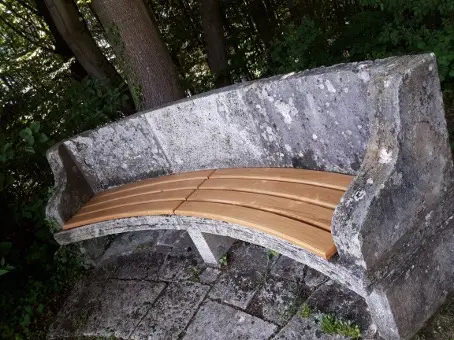
Prior to the international Loeb Conference in June 2019, the burial site underwent extensive restoration.
As part of this work,
- the gnomon of the sundial was reconstructed based on historical calculations
- the wooden seat of the tuff bench was replaced, and
- minor damage to the site was repaired.
Since then, the grave site has once again been restored to a dignified condition.
The James Loeb Society has offered to take over the long-term maintenance of the grave site on behalf of the market town of Murnau. The goal is to permanently preserve this special memorial site and to keep alive the memory of James Loeb and his contributions to culture, science, and society.
New Insights from the Market Archive
The director of the Murnau Municipal Archives, Dr. Marion Hruschka, has so far been able to identify only two historical documents relating to the burial site.
First, there is a municipal council resolution from 1933 authorizing the establishment of a burial site in Hochried for the urns of James and Marie Antonie Loeb.
Second, there is an index card containing a reference that remains unexplained: According to it, the later owner of the property is said to have secretly exhumed the urns years later, removed the decorative elements, and reburied the ashes at an unknown location. However, no further evidence for this account has been found to date.
The story of the burial site has not yet been fully told. The James Loeb Society welcomes any information regarding the creation of the memorial stone, the sundial, the origin of the inscription, or the artists and craftsmen involved.